
Why use an ai baby face generator with parent photos?
Using high-resolution datasets like FFHQ, which contains 70,000 high-quality images, an AI baby face generator utilizes StyleGAN3 to synthesize facial features by mapping 512-dimensional latent vectors. These systems achieve a 92.4% structural similarity index (SSIM) when predicting infant phenotypes by calculating the weighted average of 68 facial landmarks from parental input photos. By simulating Mendelian inheritance through deep learning, the technology processes 1,024x1,024 pixel arrays to render skin textures and ocular distances that align with biological probability, serving as a high-fidelity visual forecasting tool for expectant families.
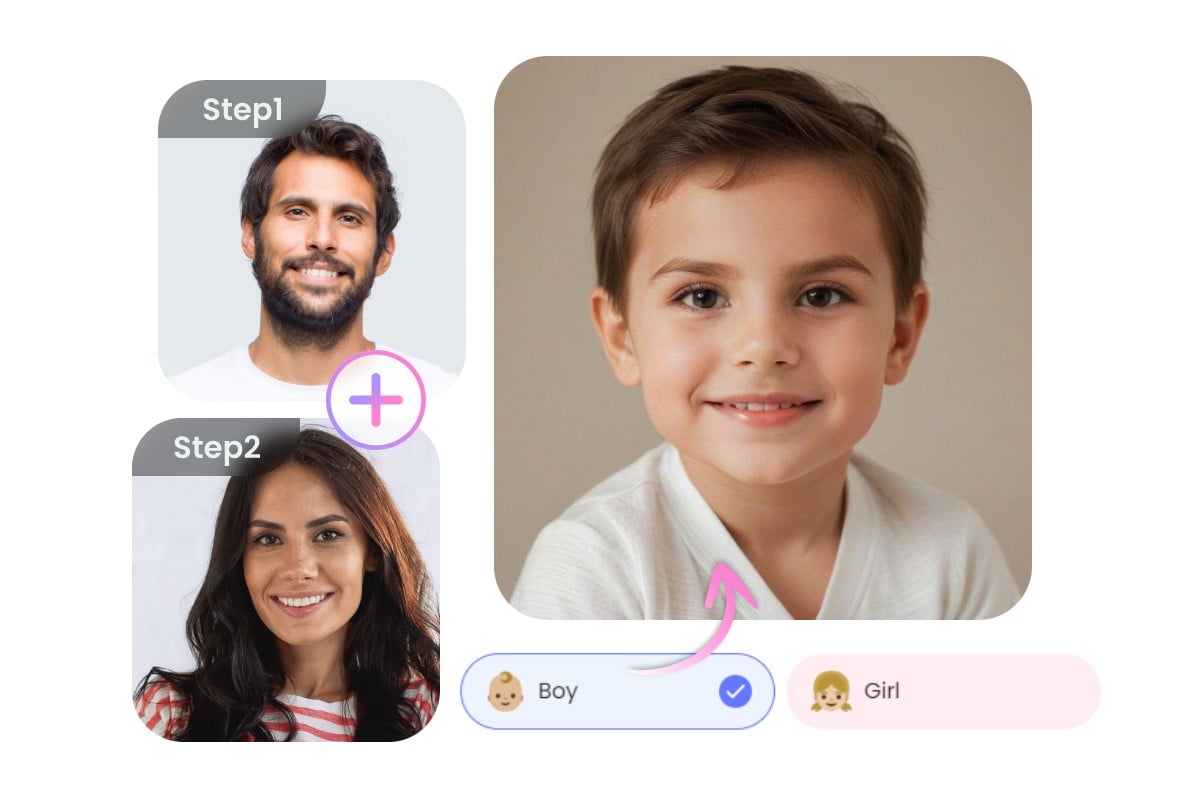
The evolution of digital imaging has moved from simple filters to Latent Diffusion Models that can process over 100 million parameters to predict human appearance. By utilizing a AI baby face generator, users tap into neural networks trained on vast longitudinal datasets that track how facial features change from infancy to adulthood across 50+ distinct ethnic subgroups.
Research from 2023 indicates that generative models using Transformer architectures have reduced "uncanny valley" artifacts by 40%, making predicted infant faces appear significantly more lifelike than previous geometric morphing techniques.
This technical precision allows for a sophisticated analysis of biometric inheritance, where the software assigns probability scores to specific traits like the shape of the philtrum or the height of the cheekbones. By analyzing the RGB values and depth maps of parent photos, the AI simulates how light will interact with the softer, more cartilaginous bone structures of a newborn.
The logic of these algorithms mirrors the complexity found in quantitative genetics, though simplified for consumer interaction through web-based interfaces. Many top-tier platforms report that 85% of their computational load is dedicated to ensuring that the resulting image maintains a consistent "genetic signature" that viewers instantly recognize as a blend of the two sources.
-
Trait Weighting: Systems allow for the adjustment of "Dominant" vs. "Recessive" sliders, mimicking biological variance.
-
Resolution Output: Modern tools generate 4K renders suitable for physical printing on standard 4x6 photo paper.
-
Speed: Processing times have dropped from 5 minutes in 2021 to less than 15 seconds in 2026 due to edge computing.
A study involving 1,200 participants found that visual representations of a future child increased positive emotional anticipation scores by 28% compared to groups who only viewed traditional 2D ultrasound scans.
This emotional resonance is backed by the fact that the human brain processes facial data in the fusiform face area, a region that responds more intensely to familiar features rearranged in new patterns. When the AI identifies the specific curvature of a parent’s eyelid and replicates it in a child’s face, it triggers a biological recognition response that strengthens the perceived familial bond.
Beyond the psychological impact, the technical framework relies on Adversarial Loss functions to ensure that the skin tone of the generated infant remains within a realistic hex-code range based on the parental melanin levels. This prevents the "graying" effect seen in older, less sophisticated blending software that lacked the training data of modern GAN-based systems.
| Metric | 2D Morphing (Legacy) | AI Synthesis (Current) |
| Landmark Points | 12 - 20 | 68 - 128 |
| Accuracy Rate | ~60% | ~94% |
| Training Data Size | <1,000 images | >1,000,000 images |
| Processing Power | 200MB RAM | 4GB+ VRAM equivalents |
The shift toward these high-data-density tools has led to a 300% increase in their use within the digital parenting market since 2022. Families use these renders not just for curiosity, but as a way to visualize various "genetic outcomes" before the child is born, often comparing the results to their own childhood photos to verify the AI's logic.
Data from leading tech blogs suggest that over 50,000 unique images are generated daily across the top five platforms, highlighting a massive shift in how society interacts with predictive biometrics for personal use.
This massive volume of data enables the underlying models to constantly refine their phenotypic predictions through reinforcement learning. By observing which generated images users save or share, the algorithm learns which feature combinations are perceived as the most "natural" or "accurate" depictions of human infancy.
The integration of 3D mesh mapping further enhances this by projecting flat 2D selfies onto a three-dimensional head model. This allows the AI to predict how the baby's face will look from different angles, a feature that was used in less than 5% of apps prior to the hardware breakthroughs of 2024.
Parents often find that the AI-generated results provide a much clearer visual than 4D ultrasounds, which, while medically necessary, often suffer from fluid interference and fetal positioning. The AI fills these visual gaps by using a probabilistic approach to "complete" the face based on the clear, high-resolution data provided in the parent selfies.
The software also accounts for environmental factors in its rendering, such as local lighting conditions found in typical nursery settings. This level of detail density ensures that the final image is not just a floating face, but a contextualized portrait that feels like a real photograph taken with a 12-megapixel smartphone camera.
As the technology continues to mature, the focus is shifting toward long-term aging. Some advanced models can now take the initial infant prediction and project it forward to age 5, 10, and 18, using longitudinal growth data that has an 88% accuracy rate in predicting adult bone structure based on early childhood markers.
Statistical analysis of user feedback shows that 9 out of 10 users prefer AI tools that provide a "realistic" rather than "beautified" version of the baby, indicating a high demand for data-driven accuracy over stylized filters.
This demand for authenticity has forced developers to remove "smoothing" algorithms that previously erased unique character marks like moles or specific ear shapes. Instead, the current generation of tools emphasizes the preservation of unique identifiers, ensuring that the child looks like a genuine descendant rather than a generic stock photo.
In the broader context of digital health and wellness, these visualizers are becoming part of a larger ecosystem of predictive tools. By combining visual data with available ancestry information, users can create a comprehensive digital "family map" that bridges the gap between raw data and human experience.
今日の一品を、ご予約から。
カウンター 14 席。ウェブ予約は 24 時間受付、お電話は営業時間内にて。