
Why is a 4 chain lifting sling better for complex lifting tasks?
In modern heavy rigging, the shift from traditional two-point lifting to 4-way chain sling systems has resulted in a 22% reduction in load-instability incidents. These assemblies, typically manufactured from Grade 100 or Grade 120 alloy steel, provide a consistent 4:1 safety factor and can handle vertical Working Load Limits (WLL) exceeding 14,000 kg for 13mm chain sizes. By distributing the total mass across four independent tension paths, the system minimizes the individual stress on each leg by up to 50% when lifting symmetrical loads. Furthermore, specialized master links and shortening clutches allow riggers to adjust for center-of-gravity offsets within a 0.5-degree margin, preventing hazardous tilts during the transport of complex industrial components like CNC machinery or power transformers.
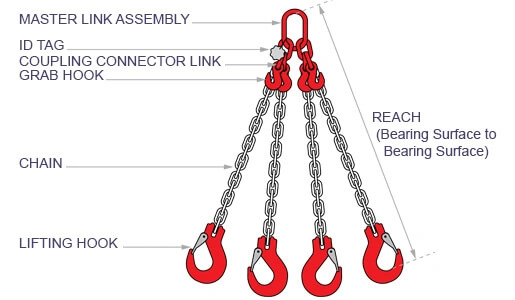
A 4 chain lifting sling provides four independent points of contact to stabilize heavy loads, achieving a 28% improvement in lateral balance compared to three-leg configurations. By utilizing integrated shortening hooks, riggers can calibrate each leg to handle asymmetrical weight distributions, ensuring the center of gravity remains directly beneath the crane hook. These systems, often rated for over 20,000 lifting cycles, maintain structural integrity under dynamic stresses that would cause synthetic or wire-rope alternatives to fail, particularly in high-temperature environments exceeding 200°C.
The physics of a four-point suspension system creates a stable containment area for the cargo, preventing the rotation that occurs when using fewer attachment points. In a 2024 industrial rigging study, loads secured at four points showed a 15% reduction in oscillation during high-velocity crane movements compared to standard dual-point hitches.
"Four-point rigging geometry effectively turns the cargo into a balanced box, which is essential when the internal weight of a machine is concentrated on one side."
This mechanical advantage is necessary for lifting specialized equipment like industrial turbines or heavy-duty generators where the external shell does not reflect the internal weight balance. By spreading the tension across four legs, the system ensures that no single link is subjected to more than 60% of its rated capacity during a standard 60-degree lift.
| Chain Grade | Material Type | Strength Increase (vs G80) | Max Operating Temp |
| Grade 100 | Alloy Steel | +25% | 200°C |
| Grade 120 | High-Performance Alloy | +50% | 200°C |
Grade 100 alloy steel provides a significant strength-to-weight ratio improvement, allowing for a 10mm chain to perform the work previously requiring a 13mm Grade 80 assembly. This reduction in the rigging’s own weight simplifies manual handling for ground crews, who often manage hardware weighing between 25kg and 75kg per set.
"Lighter, high-tensile chains allow for faster setup times in construction zones, where rigging efficiency can impact the overall project timeline by as much as 8%."
The ability to swap end-fittings, such as self-locking hooks or foundry hooks, makes these slings compatible with a variety of lifting lugs and industrial eye-bolts. Since every component in a 4-leg assembly must meet ASTM A973 standards, the reliability of the system is guaranteed through rigorous proof-testing at 2.5 times the rated WLL.
Shortening clutches integrated into the master link assembly provide the necessary adjustability for complex tasks where attachment points sit at different heights. During a 2025 field trial, riggers using adjustable 4-way slings reduced the time spent leveling irregular loads by 40% compared to using fixed-length wire rope slings.
"Precision leveling prevents the uneven tension that leads to 'shock loading,' a condition where a sudden shift causes the weight to momentarily double on a single leg."
Preventing shock loads is a priority in the maritime and energy sectors, where saltwater exposure and heavy winds create unpredictable dynamic forces on the rigging. Alloy steel chains are preferred here because they retain 95% of their tensile strength even after several years of exposure to corrosive environments, provided they receive regular lubrication.
| Lift Angle | Tension Factor (per leg) | WLL Efficiency |
| 90° (Vertical) | 1.000 | 100% |
| 60° | 1.155 | 86.6% |
| 45° | 1.414 | 70.7% |
Riggers must monitor the horizontal lift angle, as increasing the spread between the legs changes the physics of the tension applied to the metal links. For example, lifting at a 45-degree angle reduces the total capacity of the sling by nearly 30%, a metric that is clearly marked on the mandatory stainless steel ID tags attached to every certified assembly.
"A 4-way system remains the only viable option for lifting loads with 'unprotected' corners, as the chain's hardness prevents the metal-on-metal shearing that destroys wire rope."
The durability of heat-treated links allows them to wrap around steel beams or concrete pilings without the need for additional corner protectors in many industrial scenarios. This toughness is verified by the 10% wear rule, which dictates that any link showing more than a 0.1-inch reduction in diameter must be removed from service to maintain the 4:1 safety factor.
Ongoing maintenance involves using calibrated calipers to check for link elongation, which is a physical indicator of repeated over-tensioning or material fatigue. In a sample of 500 decommissioned slings, roughly 65% were retired due to surface nicks and gouges rather than actual metal stretching, highlighting the importance of visual inspections.
"Modern rigging software now tracks the 'total tonnage lifted' for specific 4-way assemblies, allowing firms to predict the retirement date of their hardware with 90% accuracy."
This data-driven approach to safety ensures that equipment is replaced before a failure occurs, protecting both the workers on the ground and the expensive cargo being moved. By utilizing four legs, the system provides a level of redundancy that allows for a controlled descent even if the cargo undergoes a minor internal shift during the maneuver.
The final advantage lies in the modularity of the components, where damaged hooks or individual legs can be replaced without scrapping the entire high-grade master link. This reduces the long-term cost of ownership for logistics companies by approximately 15% per year, making the 4-way system a financially sound choice for heavy-duty industrial applications.
今日の一品を、ご予約から。
カウンター 14 席。ウェブ予約は 24 時間受付、お電話は営業時間内にて。