
One-Stop Fragrance Sourcing: The Four Seams a Kids-Safe Buyer Should Test
One-stop sourcing removes suppliers, not decisions. A single partner that develops the fragrance, designs the pack and fills the bottle still has internal handoffs, and those handoffs are where a kids-safe project is most likely to break. The way to evaluate the claim is not to check the service list but to find the seams: formula to base, pack to fill, claim to evidence, and brand to subcontractor. Ask who owns each one in writing.
Key takeaways
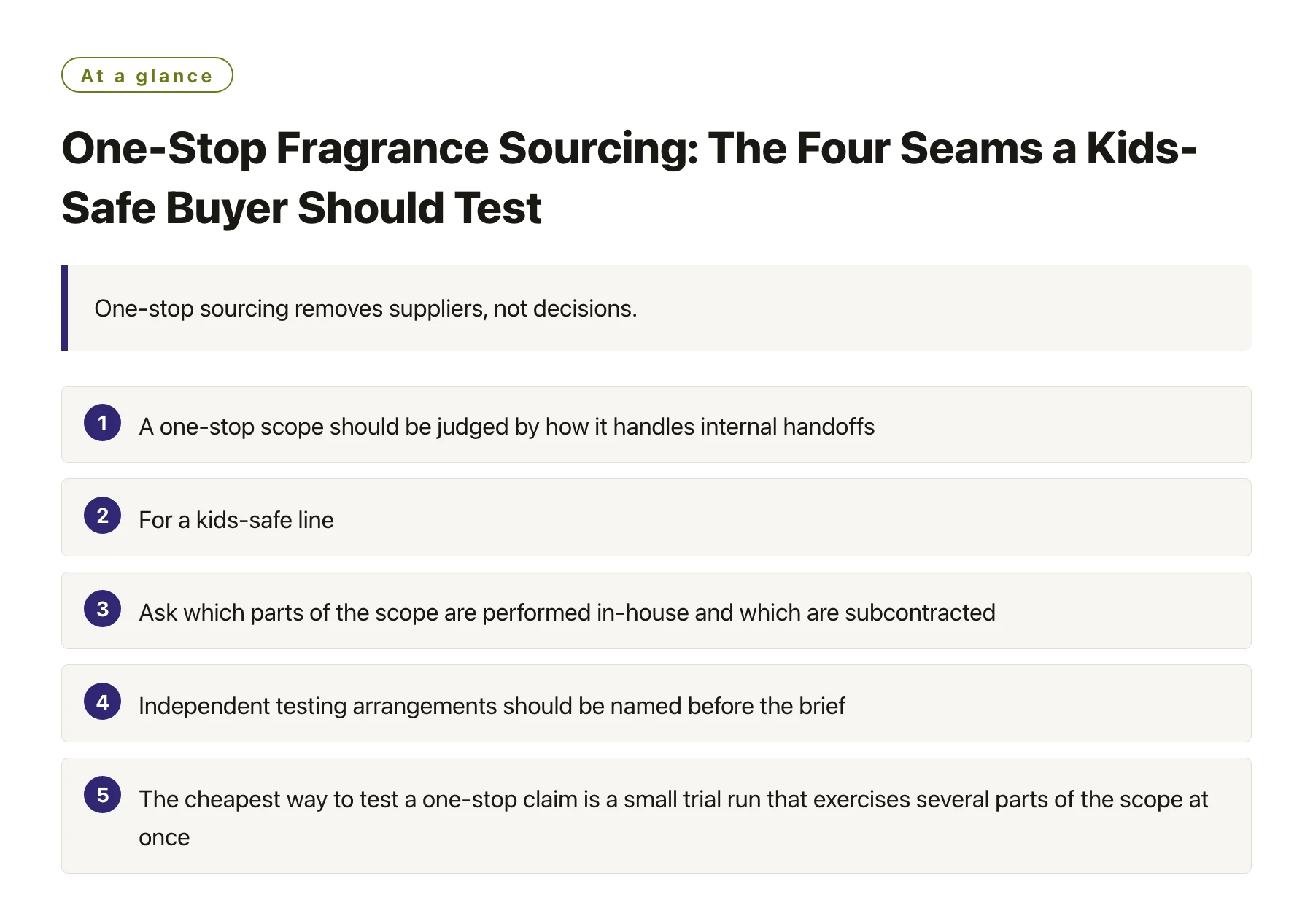
- A one-stop scope should be judged by how it handles internal handoffs, because handoffs are where responsibility is easiest to lose.
- For a kids-safe line, the critical seam is between the claim the brand wants to make and the evidence the factory can actually supply.
- Ask which parts of the scope are performed in-house and which are subcontracted, and who signs the documents for the subcontracted parts.
- Independent testing arrangements should be named before the brief, because retail buyers usually want evidence that does not come only from the factory.
- The cheapest way to test a one-stop claim is a small trial run that exercises several parts of the scope at once, not a document review.
The pitch for one-stop manufacturing is straightforward: one contract, one schedule, one point of contact, and no gaps between the fragrance, the packaging and the filling. For a first launch it is genuinely attractive, and for a family-facing product it is more attractive still, because the documentation trail is easier to assemble when it comes from one organisation.
The risk is that the convenience hides the complexity rather than removing it. A manufacturer that does everything in-house still runs several processes, and each process has its own tolerances, records and failure modes. When something goes wrong, the brand needs to know who is responsible before the problem starts, not after.
This is a guide to finding the seams in a one-stop scope quickly, with the specific questions that apply to a kids-safe brief.
One-stop means fewer suppliers, not fewer decisions
Brands often choose a full-service partner expecting to hand over a concept and receive a finished product. In practice the brand still owns the decisions that carry legal and commercial weight: the destination market, the claims on pack, the age positioning, the price ceiling and the ownership of the formula. A one-stop partner can execute those decisions; it cannot make them on the brand's behalf.
The useful framing is that a one-stop scope reduces the number of interfaces the brand has to manage, from several companies to one organisation. Inside that organisation, the interfaces still exist. Evaluation is the process of checking those internal interfaces as rigorously as the brand would check external suppliers.
What full service genuinely saves
Time and translation risk. When the same team develops the scent, sources the pack and fills it, fewer requirements get lost between documents and fewer schedules have to be reconciled. That is a real saving on a project with a fixed launch date.
What it does not save
Cost discipline and independent verification. A single partner is not competing with anyone on the pack once the contract is signed, and its own test results are not a substitute for independent evidence if a retailer asks for it. Plan for both from the start.
The four seams where a one-stop scope can still break
| Seam | Question to ask | Answer that should worry you |
|---|---|---|
| Formula to base | Who confirms the fragrance behaves in the specific base - rinse-off, leave-on, alcohol or oil - and who signs off the compatibility result? | We adapt it on the line if needed |
| Pack to fill | Who owns the decoration specification, the fill tolerances and the closure performance, and are those one team or two? | The pack supplier handles it and we fill |
| Claim to evidence | Which documents back the claims the brand wants on pack, who issues them, and what is charged separately? | We can provide whatever the buyer asks for, later |
| Brand to subcontractor | Which parts of the scope are subcontracted, and does the brand's confidentiality and quality agreement cover those parties? | That is our internal arrangement |
| Formula to ownership | Who holds the formula, what exclusivity applies, and what happens to both if the relationship ends? | We can discuss that when you place an order |
The third column is not a sign of a dishonest supplier; it is a sign of an undefined one. Most of these answers become perfectly acceptable once they are written down, named to a person and priced. What a brand should not accept is the absence of an answer before the order.
Evidence that survives a retail buyer's review
For a kids-safe line, the evaluation increasingly turns on documents rather than on impressions, because retail buyers ask for them. It is worth knowing in advance which evidence will come from the factory and which should come from an independent laboratory, and what each of those costs.
Independent testing providers publish the scope of cosmetic and personal care testing they perform, and asking a supplier how it has arranged such testing in the past is a better question than asking whether it can [1]. The answer reveals whether testing is a routine step in its process or an exception it has to organise for you.
Industry-level expectations are moving in the same direction
The cosmetics industry's own associations work on safety, science and responsible sourcing as shared priorities rather than individual company preferences, which is why a manufacturer's familiarity with that agenda is a reasonable signal [2]. It does not replace a specific document, but it does indicate whether the supplier's systems were built with these expectations in mind.
Broader work on chemicals and pollution points the same way: knowing what is in a formulation and what happens to it after use is becoming a normal part of responsible manufacturing rather than a specialist exercise [3]. A supplier that can describe its material documentation without being prompted is usually operating at that standard.
Ask for the retention and traceability answer before you ask for the price. If a batch is questioned eighteen months after delivery - because a customer reported a reaction, or a retailer ran its own check - can the manufacturer trace the fragrance lot, the component lot and the fill record for that specific unit? A one-stop partner that can answer that question quickly is offering something more valuable than a lower unit cost. If the answer requires a search, find out how long the search takes before you commit, because records kept informally are the same as records not kept.
How to test the scope before committing to volume
Document review only goes so far. The most informative step is a small trial that exercises several parts of the scope at once, so the brand can watch the handoffs rather than read about them.
Run one sample through the whole scope
Commission a single sample with the packaging and the decoration included, not just the fragrance. This forces the formula, the pack and the fill tolerances to meet each other early. If the supplier can support both OEM and ODM fragrance production, ask for one version of each so you can see how it handles a brief with a supplied concept and a brief that starts from its library both OEM and ODM fragrance production.
Ask to see where the work happens
A visit answers questions that no document will. Look at how samples are stored, how batch records are completed and whether the documentation area is organised. A scent museum is not a factory tour, but a supplier that runs one is maintaining a public-facing space where the environment has to be stable and repeatable, and that is a small piece of evidence about operating discipline Xuelei's scent museum. Treat it as one data point, not as proof of manufacturing quality.
Write the responsibilities into the contract
Whatever the answers reveal, put them in the agreement: who owns the formula, who is responsible for which tests, what happens to the moulds and artwork if the relationship ends, and what records are retained for how long. A contract manufacturer for perfume brands is offering a service, and a service is only as good as its scope statement a contract manufacturer for perfume brands. The point of the evaluation is to make that statement specific before the first order, not to find a supplier that never needs one.
Sources
- SGS: Cosmetics, Personal Care & Household Testing —— Testing, inspection and certification services for cosmetics and personal care, including microbiological, stability and safety testing aligned with cosmetics GMP.
- Cosmetics Europe —— The European trade association for the cosmetics and personal care industry, publishing guidance, positions and market information.
- UNEP: Chemicals and Pollution Action —— The UN Environment Programme's pages on chemicals management, including the sound management of chemicals in products.
Frequently asked questions
Is one-stop fragrance manufacturing cheaper than splitting the supply chain?
Not necessarily per unit, because a single partner faces less competitive pressure on the parts it supplies. It often costs less overall on a first order, because fewer interfaces mean fewer scheduling delays and fewer duplicated set-ups. Compare the two on total project cost and risk, not on unit price.
What should I ask a one-stop supplier that I would not ask a specialist?
Ask which parts of the scope are subcontracted and who signs the documents for those parts. A specialist does one thing, so its boundary is obvious; a full-service partner's boundary is internal and has to be described.
How important is independent testing for a kids-safe line?
It depends on the retail channel, but it is safer to plan for it. Buyers frequently ask for evidence from a laboratory that is not the manufacturer's own, and arranging it early is cheaper and faster than arranging it after production.
What is the fastest way to evaluate a full-service claim?
Commission one sample that includes the pack and the decoration, then watch how the supplier handles the interfaces. A supplier that coordinates the parts well will surface constraints early; one that does not will discover them at the fill stage.
Should the brand's confidentiality agreement cover subcontractors?
Yes. If any part of the scope is subcontracted, the agreement should say so explicitly and require equivalent confidentiality from those parties. Ask for the list of subcontracted processes rather than assuming the answer.
今日の一品を、ご予約から。
カウンター 14 席。ウェブ予約は 24 時間受付、お電話は営業時間内にて。